Building a Strong Foundation: A Therapist’s Guide to Your Child’s Developmental Pyramid
Posted on: January 19, 2026 by admin9876
 29 View
As a therapist, I often meet parents who are concerned about their child’s behaviour, emotional regulation, or learning challenges. They are frequently focused on the specific issue at hand, such as a tantrum, a reading difficulty, or social anxiety. While these concerns are valid, it is often more helpful to look beneath the behaviour to the underlying foundation that supports all development.
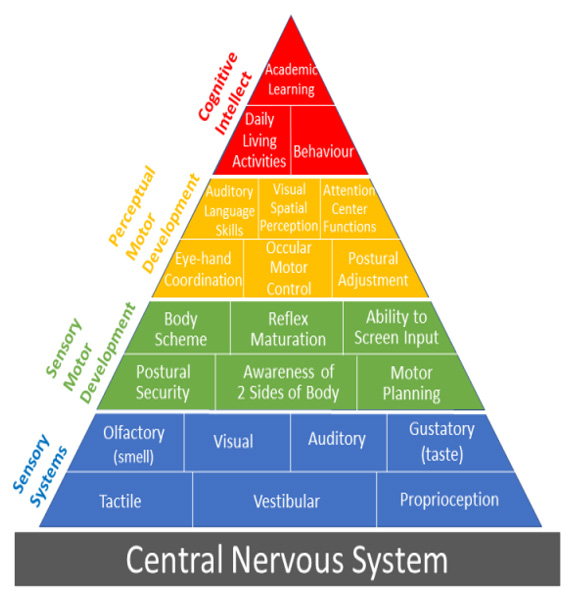
The Developmental Pyramid is a powerful model that illustrates how a child’s capacities are built, layer by layer, from the ground up. Just as a house requires a solid foundation to remain stable, a child’s higher-level skills depend on the robust development of the foundational layers below.
When we see challenges at the top, the root cause often lies in a weakness or instability in a lower level. Let’s walk through each layer of this pyramid to understand what it means for your child.
The Foundation: Sensory Integration & Processing
This is the absolute base of everything. From birth, your child’s brain is like a busy reception desk, taking in information from all their senses: sight, sound, touch, taste, smell, as well as the “hidden” senses of balance (vestibular) and body awareness (proprioception).
In simple terms: This is how your child’s nervous system understands the world around and inside them.
What it looks like when it’s strong: A child can filter out unimportant background noise to focus, enjoys different types of touch, coordinates their body well, and feels comfortable moving and playing.
Signs of difficulty: A child might be overly sensitive to sounds or tags on clothing, constantly seek crashing and spinning, appear clumsy, or have difficulty sitting still. They may seem “out of sync” with their environment. Without a solid sensory foundation, all the layers above struggle to find stability.
Level 2: Sensory-Motor Development
Built directly upon sensory integration, this layer is about the vital connection between sensing the world and moving within it. It’s the “doing” layer.
In simple terms: This is how your child learns to use their body effectively in response to what they feel and see.
What it looks like when it’s strong: A child develops core strength, coordination, balance, and the ability to plan and execute physical actions (like climbing a ladder or catching a ball).
Signs of difficulty: You might see poor posture, a weak grip, difficulty with stairs, avoidance of playground equipment, or general awkwardness in movement. These motor skills are the building blocks for the next critical layer.
Level 3: Perceptual-Motor Development
This is where the body and the mind begin to work together more closely. Your child starts to interpret sensory information and use it to perform more complex, learned tasks.
In simple terms: This is how your child makes sense of what they see and hear, and connects it to their movements.
What it looks like when it’s strong: A child can easily copy shapes, recognise letters, follow a rhythm, and understand spatial concepts like “in,” “on,” or “behind.”
Signs of difficulty: Challenges with reading readiness, letter reversals, difficulty with puzzles, and trouble following multi-step instructions can originate here. This layer is crucial for academic readiness.
Level 4: Language & Cognition
Now we reach the higher-level skills that are often the focus in school. This layer encompasses thinking, reasoning, problem-solving, and all aspects of language.
In simple terms: This is your child’s ability to think, understand, communicate, and remember.
What it looks like when it’s strong: A child can express their thoughts and feelings clearly, understand stories, reason through problems, and engage in imaginative play.
Signs of difficulty: Struggles with vocabulary, sentence structure, following conversations, or logical thinking may be apparent. It is essential to remember that language and cognition are supported by the motor and perceptual layers below. You cannot have strong, clear thinking without a body that can effectively support and feed information to the brain.
The Peak: Academic & Emotional Well-Being
This is the summit of the pyramid—the outcome we all hope for. It represents a child’s ability to learn successfully in a formal setting and to manage their social and emotional world.
In simple terms: This is how your child performs in school and how they feel about themselves and their relationships.
What it looks like when it’s strong: A child is able to learn, form healthy friendships, regulate their emotions, and have a positive self-image.
Signs of difficulty: This is where many parents first seek help. We may see academic struggles, anxiety, frequent meltdowns, poor social skills, or low self-esteem. It is tempting to address only these top-level symptoms with tutoring or behaviour charts. However, the pyramid shows us that lasting change requires us to look down and strengthen the base.
What This Means for You as a Parent
If your child is facing challenges, do not blame yourself or assume the problem exists in isolation. The Developmental Pyramid offers a hopeful perspective: by identifying and supporting the weaker layers, we can create positive change that ripples upward.
A therapist trained in this developmental approach can help you understand which parts of your child’s foundation need shoring up. This often involves playful, physical activities that promote sensory integration and motor planning, which in turn build a stronger platform for learning and emotional regulation.
Your child is not being difficult on purpose. They are likely struggling because a part of their developmental foundation is shaky. By building from the ground up, we can help them reach their maximum potential with stability and confidence.
Disclaimer: This article is for informational purposes only and is not a substitute for professional therapeutic or medical advice.
Generate the picture of developmental pyramid as in the website
Key Takeaway: This visual model powerfully demonstrates why we must look “down the pyramid” to find the root causes of challenges manifesting at the top. You cannot have strong academic and emotional well-being without a solid sensory-motor foundation.